AI Is Changing How Indians Search for Information — What Comes Next?
From short keyword searches to long, conversational questions, AI is reshaping how people in India discover, understand and verify information online.
By Editorial Desk7 min read
Share this story
AI is changing the way Indians find and consume information online. From conversational questions and voice searches to visual discovery and AI-generated answers, the traditional search experience is evolving and the change could reshape how users, businesses and news publishers approach the internet.
The Search Box Is No Longer Just a Search Box
For years, searching online followed a familiar pattern: type a few keywords, scan the results and open websites one by one. This behaviour is now beginning to change as artificial intelligence becomes increasingly integrated into search platforms and information discovery.
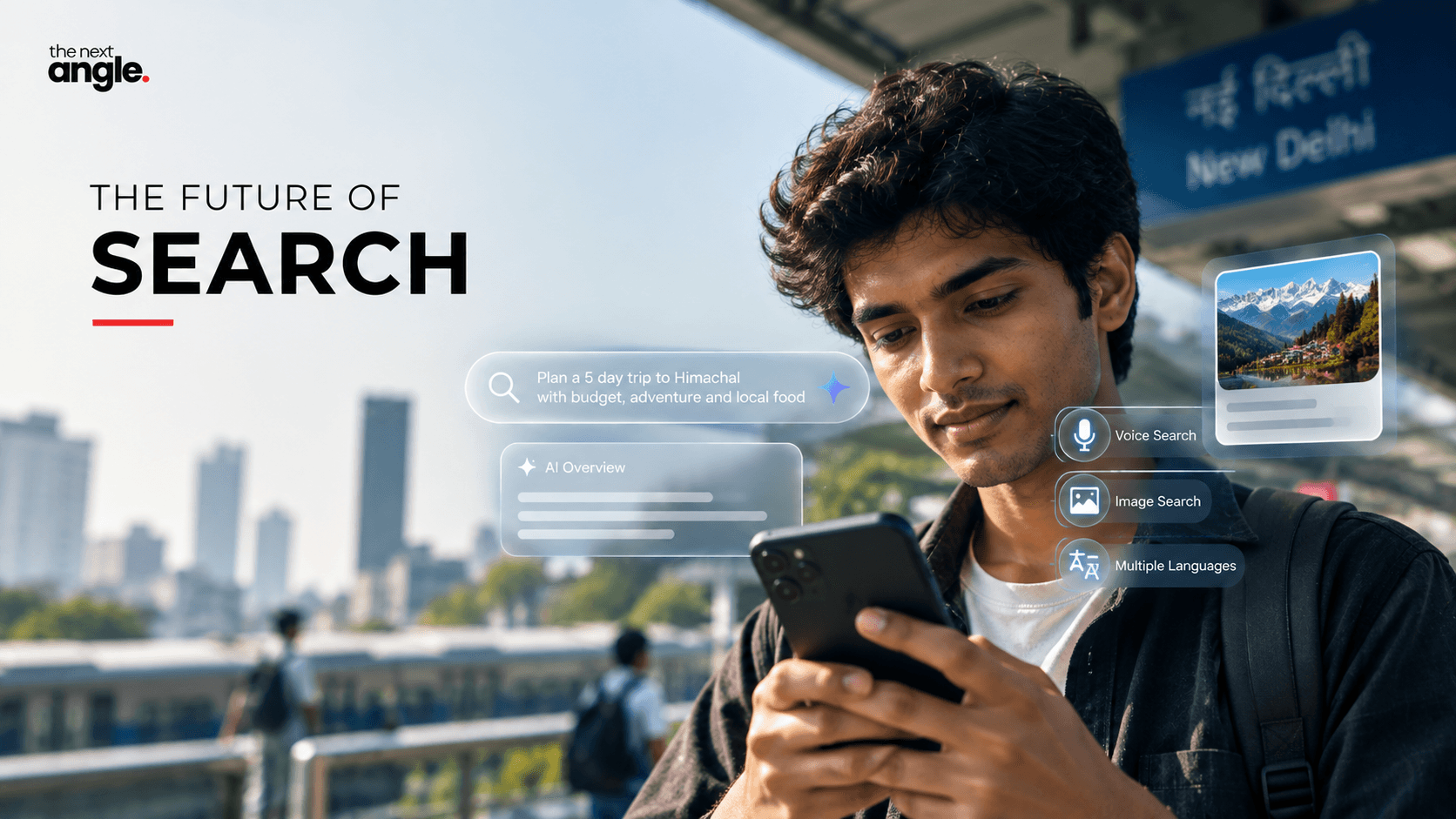
Instead of simply entering a short keyword phrase, users can increasingly ask detailed questions, provide context, upload an image or continue a conversation with follow-up questions. Search is gradually becoming less about finding a list of links and more about understanding an entire question.
From Keywords to Conversations
The biggest change may not be the technology itself, but the way people formulate questions. A traditional search might involve a few keywords such as “best places to visit in Rajasthan”, while an AI-powered query can include budget, duration, interests and personal preferences in a single question.
India’s Semiconductor Shift: The Bigger Race Is Beyond Making Chips
This makes search more conversational. Instead of asking a search engine to locate information, users can increasingly ask an AI system to organise that information around a specific requirement and explain it in a way that is easier to understand.
India Is Becoming an Important AI Search Market
India's enormous and increasingly multilingual internet audience makes the country an important market for the evolution of AI-powered search. Google has expanded AI-powered Search experiences in India, including AI Mode and support for multiple Indian languages.
This matters because India's internet audience does not operate in a single language or through a single search behaviour. A student in Delhi, a small-business owner in Bihar and a traveller in Kerala may all approach the same information problem differently.
Search Is Becoming Multimodal
Text is no longer the only way people can search for information. Voice, images and camera-based searches are increasingly becoming part of the discovery process, allowing users to identify objects, understand places and ask questions without necessarily knowing the right keywords.
Google has reported particularly strong adoption of visual search in India, with Google Lens becoming an increasingly important way for users to discover information. This points towards a future where “searching” can begin with a photograph or spoken question rather than a typed sentence.
The Rise of the Second Question
One of the most interesting changes created by conversational AI is the ability to continue asking questions. A user may start by asking what a particular policy, technology or event is, and then immediately ask why it matters, who is affected and what could happen next.
That creates a different information journey. Instead of opening several websites and manually connecting the information, users can increasingly move through a sequence of related questions. For publishers, this makes anticipating the reader's next question more important than simply answering the first one.
What Does This Mean for News Websites?
The shift has particular importance for digital news publishers. If AI systems can quickly provide a basic summary of an event, simply repeating information already available elsewhere may become less useful to readers.
News organisations may therefore need to focus more heavily on original reporting, context, primary documents, data, expert perspectives and local experiences. The value of an article can increasingly come from what it adds to the basic information rather than simply repeating what happened.
The Competition May Be for Context
Consider two articles covering the same event. One explains what happened, while another explains what happened, why it happened, what led to it, who is affected and what the available data tells us.
The second approach gives the reader a broader understanding of the story. As AI makes basic information easier to summarise, context, interpretation based on evidence and original reporting could become increasingly important parts of digital publishing.
Why This Matters for The Next Angle
This changing search environment creates an opportunity for publications that focus on a distinct perspective. The objective should not be to compete with AI at producing generic summaries, but to provide information, context and questions that help readers understand a story beyond the obvious headline.
For The Next Angle, that means looking for the question behind the question. Instead of stopping at “What happened?”, the article can also explore “Why does it matter?”, “What are we missing?” and “What could this mean next?”
AI Does Not Remove the Need to Verify Information
The growing use of AI for information discovery also creates a major responsibility for users. AI-generated answers can sometimes contain incomplete, outdated or incorrect information, even when the response sounds confident and convincing.
For important subjects such as government policies, financial decisions, legal matters, health information and breaking news, readers should continue checking reliable primary or authoritative sources. AI can make information discovery faster, but speed should not be confused with accuracy.
India's Digital Scale Makes the Shift Bigger
India already has one of the world's largest digital populations, meaning changes in online behaviour can have effects across education, business, journalism, entertainment and everyday decision-making. As more people use smartphones and internet services, the way information is searched and consumed becomes increasingly important.
The next phase of India's internet may therefore not simply be about bringing more people online. It could also be about changing how existing internet users interact with the enormous amount of information that is already available to them.
What Comes Next?
The direction of search is becoming increasingly clear: longer questions, conversational interactions, voice queries, visual discovery and AI-generated summaries are becoming part of the online information experience.
The exact long-term outcome is still developing, but one thing is already changing—the relationship between users and search engines. People are increasingly expecting technology not just to find information, but to help them understand it.
The Next Angle
The AI search revolution is often described as a technology story, but the deeper change is about human behaviour. People are moving from simply searching for information towards asking systems to organise, explain and connect information for them.
That creates a new challenge for everyone who produces content. When basic answers become easier to generate, useful context, original reporting and genuinely different perspectives can become more valuable. The future of online publishing may increasingly depend on who can help readers understand not just what happened, but why it matters.