India’s Small Businesses Are Going Digital: How MSMEs Are Changing the Indian Economy
From digital payments to online marketplaces and faster access to formal systems, India’s small businesses are entering a new phase of digital commerce.
By Editorial Desk8 min read
Share this story
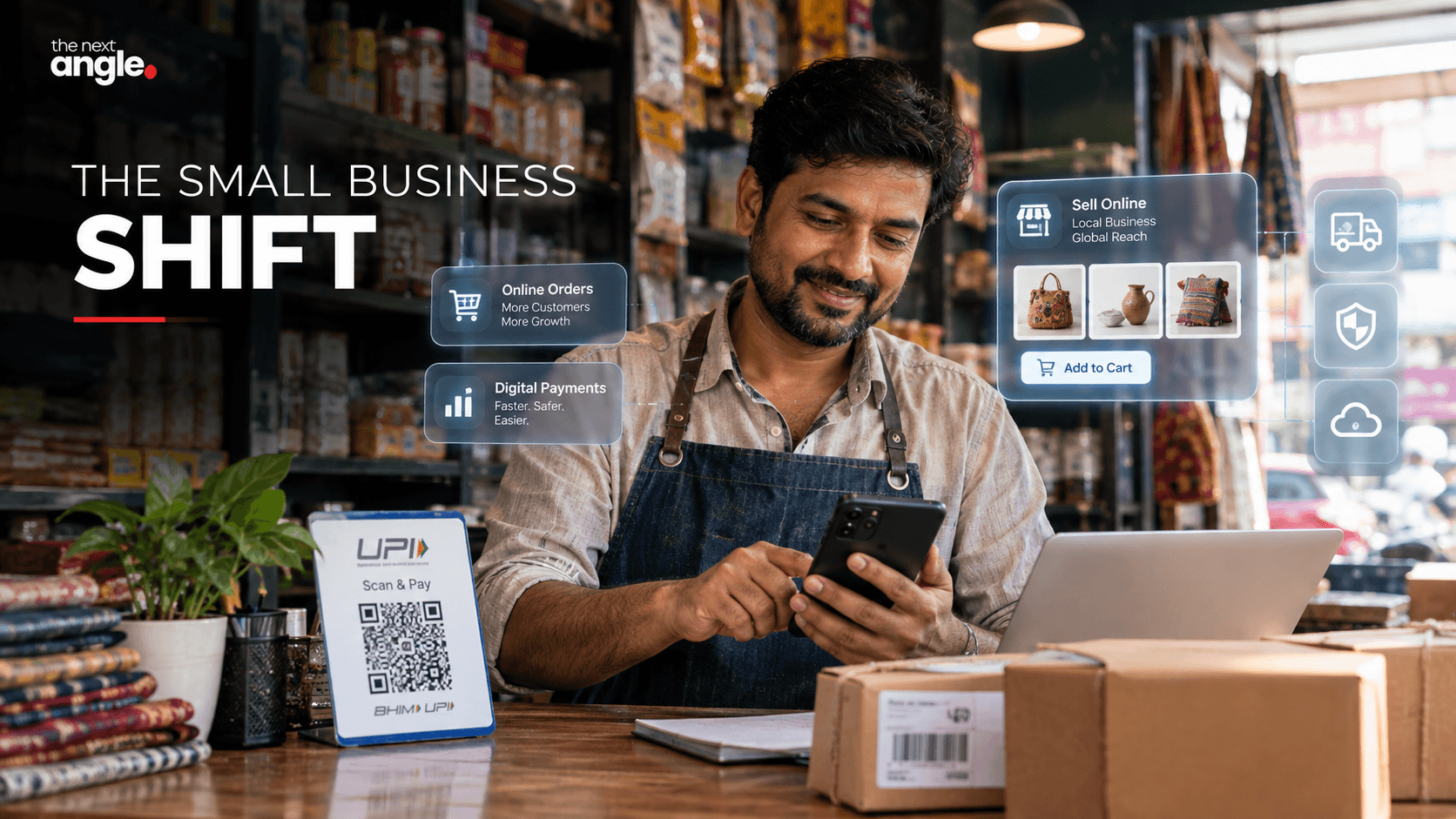
India’s small business sector is undergoing a quiet digital transformation. Beyond UPI and digital payments, MSMEs are increasingly using e-commerce, ONDC, online registration, digital accounting and other technology platforms to reach customers, manage operations and participate in India’s growing digital economy.
India’s Small Business Economy Is Entering a New Digital Phase
When people talk about India’s digital economy, the conversation usually revolves around startups, artificial intelligence, large technology companies and digital payments. But one of the most important changes is happening at a much smaller level in neighbourhood shops, home businesses, local manufacturers, artisans, service providers and micro enterprises.
India’s MSME sector is increasingly becoming part of the country’s digital economy. Digital payments were one of the first major steps, but businesses are now moving towards online commerce, digital registration, e-commerce platforms, digital accounting and technology-enabled financial services.
UPI Started the Digital Business Revolution
For millions of Indian businesses, digital transformation began with a QR code.
A customer could walk into a small shop, scan a UPI QR code and complete a payment within seconds. For the business owner, this reduced dependence on cash and made digital transactions part of everyday commerce.
UPI Is Changing: What the New ₹2,000+ Payment Rule Really Means for Indians
The scale is substantial. Government data says UPI accounted for 85% of India's digital payment transactions by volume in FY 2025-26, while the platform had more than 55 crore users and 6.5 crore merchants.
But digital payments may only have been the first layer of India's small business digital transformation.
The Bigger Shift Is Happening Beyond Digital Payments
A business accepting UPI is digital in one sense, but that does not necessarily mean the business has entered the wider digital economy.
The more significant transformation happens when a small business starts using technology to manage inventory, maintain accounts, find customers, sell products online, receive orders, organise logistics or access formal financial systems.
The government is now explicitly tracking MSME digital adoption across areas such as e-commerce, digital accounting, supply-chain digitisation, GeM and ONDC participation.
That represents a much broader definition of digitalisation.
MSMEs Are Becoming More Visible in the Formal Economy
Digital registration is another important part of this transition.
The Ministry of MSME's dashboard showed more than 9.60 crore enterprises registered through Udyam and Udyam Assist as of September 17, 2026, highlighting the scale at which India's micro and small enterprises are entering formal digital systems.
Formalisation can give eligible enterprises better visibility within government systems and can make participation in various support programmes easier.
For a small entrepreneur, therefore, digitalisation is not only about selling something online.
It can also be about creating a recognised digital identity for the business.
ONDC Could Change How Small Businesses Find Customers
One of the biggest developments in digital commerce in India is the Open Network for Digital Commerce, commonly known as ONDC.
Unlike a conventional closed marketplace, ONDC is designed as an open network connecting different buyer and seller applications. The model is intended to reduce some barriers that smaller businesses face when entering digital commerce.
This is important because building a complete e-commerce operation can be expensive and complicated for a small business.
An open digital network can potentially allow a local seller to become discoverable to customers beyond the immediate neighbourhood.
The Government Is Helping Small Businesses Enter E-Commerce
The MSME TEAM Initiative, operated under the Raising and Accelerating MSME Performance programme, is specifically focused on helping micro and small enterprises participate in digital commerce through ONDC.
The initiative provides support across areas including onboarding, product cataloguing, packaging, logistics and customer management. Its stated target is to benefit 5 lakh micro and small enterprises, with half of the targeted beneficiaries being women-owned enterprises.
This is significant because simply putting a business online does not guarantee that it can operate successfully online.
A seller needs product photographs, catalogues, packaging, order management, logistics and customer support as well.
Local Businesses Can Potentially Reach Markets Beyond Their Cities
The internet changes the geography of commerce.
A traditional retailer generally depends heavily on customers who can physically reach the shop. A digital storefront can potentially expose the same business to customers outside its immediate location.
Government data released in 2026 said ONDC had crossed 20 crore buyers and 5 lakh sellers, with a presence in around 1,000 cities by June 2026.
For Indian MSMEs, this creates an interesting possibility: a business can remain physically local while becoming digitally national.
That distinction could become increasingly important for artisans, home-based entrepreneurs, regional food businesses and small manufacturers.
Rural India Is Part of the Digital Business Story
India's digital transformation is not limited to major metropolitan cities.
Government initiatives are increasingly focusing on artisans, rural entrepreneurs, self-help groups, local retailers and traditional businesses. The Ministry of MSME has also highlighted ONDC onboarding and marketing support for local products and traditional handicrafts.
For these businesses, digital commerce can potentially solve a longstanding problem: limited market access.
A product may be made in a small town or village, but its potential customer base no longer has to remain limited to that geographical area.
Digital Accounting Could Change How Small Businesses Manage Money
Another important part of MSME digitalisation in India is the move towards digital business records.
Digital accounting can help businesses organise sales, expenses, invoices and other financial information in a more structured way. It can also make business information easier to access when an entrepreneur needs to understand cash flow or prepare financial records.
Government assessments of MSME digital adoption specifically include digital accounting and supply-chain digitisation, showing that policymakers increasingly view technology adoption as broader than online payments.
The QR code may be visible to the customer, but the accounting system behind the business can be just as important.
Digital Commerce Does Not Automatically Mean Digital Success
There is an important distinction between being online and succeeding online.
A small business can have a digital payment system but still struggle with customer acquisition. It can have an online catalogue but lack good product photographs. It can receive online orders but struggle with packaging or logistics.
This is why digital literacy and business capability matter alongside internet access.
The government's MSME TEAM programme includes support for cataloguing, logistics, packaging and customer management precisely because successful e-commerce for small businesses requires more than simply creating an online listing.
India's Small Businesses Are Becoming Part of Digital Public Infrastructure
The larger story is that India has built several layers of digital infrastructure that businesses can increasingly use.
UPI handles digital payments. Udyam provides a digital framework for MSME registration. ONDC creates an open digital-commerce network. Other platforms and government systems are increasingly connecting businesses with procurement, finance and services.
Together, these systems create something bigger than individual apps.
They create a digital infrastructure through which small businesses can increasingly participate in the formal economy.
The Numbers Show How Large the Opportunity Is
The scale of India's MSME ecosystem makes this transformation economically significant.
Government data in August 2026 said the MSME sector accounted for 31.1% of India's GDP, 35.4% of manufacturing output and 48.58% of exports. The same government release said Udyam registrations had reached 9.16 crore at that point.
This means that digital adoption among small businesses is not a niche technology story.
If technology changes how even a portion of these enterprises sell, manage money, access customers or organise operations, the impact can spread across employment, manufacturing, services and trade.
The Next Generation of Indian Small Businesses May Look Different
The traditional image of a small business is changing.
A shop can have a physical location and an online customer base. An artisan can work from a small town while selling products through digital channels. A manufacturer can communicate with customers, manage orders and maintain digital records without building a large corporate infrastructure.
This does not mean physical businesses are disappearing.
Instead, the boundary between offline business and online business is becoming increasingly difficult to define.
A small business can now be both.
The Challenge: Digital Skills Must Catch Up
Technology can provide infrastructure, but business owners still need the ability to use it.
Understanding online marketplaces, digital marketing, cybersecurity, customer communication, inventory systems and digital accounting can become increasingly important as more commercial activity moves online.
The next phase of India's digital economy may therefore depend not only on providing businesses with access to technology, but also on helping entrepreneurs develop the skills required to use that technology effectively.
What This Means for India's Digital Economy
India's digital transformation is often measured through payment volumes, internet users and smartphone adoption.
But the next important measurement could be deeper: how effectively small businesses use digital infrastructure to grow.
If more MSMEs can find customers outside their local markets, maintain better business records, access digital commerce and participate in formal financial systems, India's digital economy could increasingly become an economy where even very small enterprises have access to national-scale infrastructure.
The Next Angle
India's small-business digital revolution is not happening through one dramatic technological breakthrough.
It is happening through thousands of everyday changes - a QR code at a local shop, a digital registration, an online catalogue, an ONDC listing, a digital invoice or a customer discovering a local product from another part of India.
The real story is therefore bigger than UPI adoption or online shopping.
India is gradually building a digital environment in which a small business can remain local in size while becoming much larger in reach. The next stage of India's digital economy may be defined not by how many businesses simply use technology, but by how many small businesses can use it to find markets, improve operations and compete in a much larger economy.