UPI Is Changing: What the New ₹2,000+ Payment Rule Really Means for Indians
India’s UPI ecosystem is entering a new phase as a proposed merchant-side charge changes the economics of larger digital payments.
By Saurabh Mahto4 min read
Share this story
UPI users may not face a direct charge for everyday payments or money transfers, but eligible high-value merchant transactions could introduce a new cost structure from October 15, 2026.
UPI’s “Free” Era Is Entering a New Phase
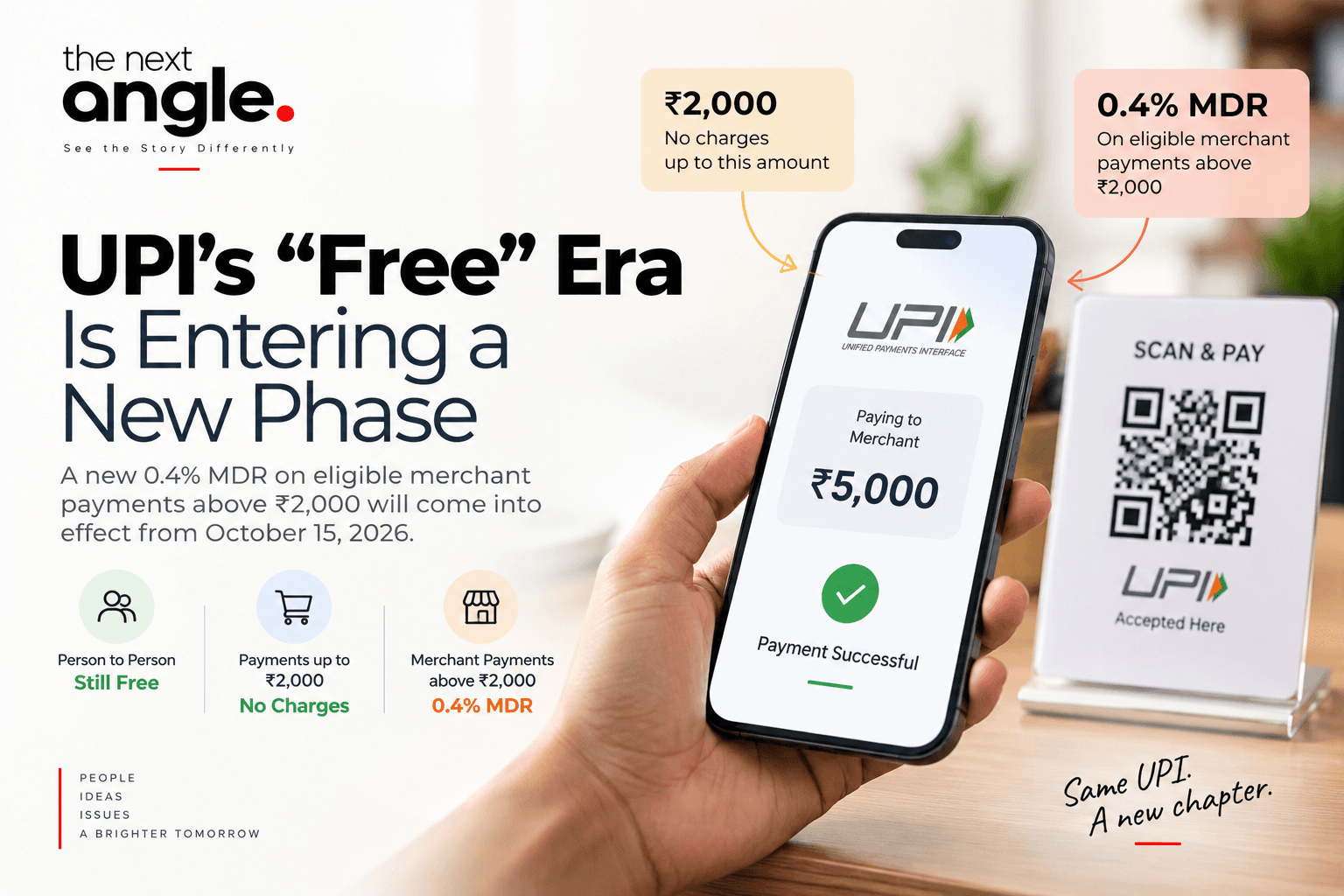
India’s UPI ecosystem is set for a significant change. The National Payments Corporation of India (NPCI) has announced a 0.4% Merchant Discount Rate (MDR) on eligible Person-to-Merchant (P2M) UPI transactions above ₹2,000, with the new framework coming into effect from October 15, 2026.
For consumers, however, the headline needs some context. This is not a blanket charge on every UPI payment above ₹2,000, nor does it mean that sending money to a friend or family member will suddenly become chargeable. Person-to-person UPI transactions will continue to remain free.
What Exactly Is Changing?
The new MDR applies to eligible payments made from an individual to a merchant through UPI when the transaction value exceeds ₹2,000.
For example, a ₹5,000 eligible merchant payment would attract an MDR of ₹20, while a ₹10,000 transaction would attract ₹40 under the 0.4% rate.
For general merchant transactions of ₹75,000 or more, the MDR will be capped at ₹300 per transaction.
India Faces New 100% US Tariff Risk: What the Russia Oil Bill Could Mean for Trade
The important point is that MDR is a merchant-side payment cost, rather than a new fee that UPI users are simply being asked to pay at checkout.
***Will You Be Charged for Sending ₹5,000 to Someone? - No.
A ₹5,000 transfer to a friend, family member or another individual is a Person-to-Person (P2P) transaction. The new MDR framework does not apply to such transfers.
The distinction is between P2P payments and P2M payments.
So, the statement that “UPI will now charge 0.4% on payments above ₹2,000” is incomplete without explaining whether the payment is being made to an individual or a merchant.
What Happens to Payments Below ₹2,000?
The government has separately specified that banks and payment-system providers cannot impose direct or indirect charges on UPI transactions of up to ₹2,000.
That keeps the low-value segment of UPI protected from charges under the new framework.
For millions of Indians using UPI for everyday purchases, this threshold is therefore particularly important.
Why Is the Government Bringing MDR Back?
UPI has grown into one of the world’s largest real-time payment systems.
In August alone, UPI processed around 24 billion transactions worth approximately $311 billion, according to Reuters. The scale means that banks, payment companies and infrastructure providers are handling an enormous volume of transactions while maintaining the technology, security and systems required to keep the network running.
The new framework is intended to help support investment in areas including payment infrastructure, innovation, cybersecurity and customer service.
What About Railways, Fuel and Other Sectors?
Not every sector will follow exactly the same structure.
For certain categories, including railways, telecom, insurance and fuel, the framework provides for a flat ₹5 MDR rather than the general 0.4% structure.
This means the impact will depend not only on the size of a transaction but also on the type of merchant receiving the payment.
Can Merchants Pass the Charge Directly to Customers?
This is where the new system becomes important for consumers.
The current framework does not allow merchants to directly transfer the MDR to customers as a separate UPI charge.
However, the broader economic effect is something to watch.
Businesses may absorb the cost, adjust margins or make other changes to their pricing and payment strategies. That does not mean customers will automatically pay more, but the possibility of indirect effects makes the policy significant beyond the payment screen.
Why ₹2,000 Matters More Than 0.4%
The real story may not be the percentage.
It is the threshold.
India is effectively trying to preserve UPI’s low-cost character for everyday payments while creating a revenue mechanism around higher-value commercial transactions.
This creates a new model: small payments remain protected, P2P transfers remain free, and larger merchant transactions contribute to the cost of the payment ecosystem.
This is a significant shift from the earlier zero-MDR model that helped UPI expand rapidly across India.
The Next Angle: Is UPI Still “Free”?
The answer depends on what you mean by free.
For the ordinary user transferring money to another person, yes, UPI remains free.
For low-value transactions up to ₹2,000, the government has also protected users from charges.
But for certain larger merchant transactions, the economics behind UPI are changing.
And that is the more important story.
For years, UPI’s biggest advantage was its simplicity: scan, pay and move on.
Now, India’s digital-payment system is entering a phase where the question is no longer only about adoption. It is also about who pays to keep one of the world’s largest instant-payment networks running at massive scale.
What This Means for You
If you use UPI to send money to friends or family, nothing changes.
If you make everyday UPI payments of up to ₹2,000, they remain protected from charges under the government notification.
If you make a larger payment to a merchant, the new MDR framework may apply from October 15, 2026.
The immediate impact on consumers may therefore be limited. However, the change could have a much bigger long-term impact on merchants, banks, payment apps and the economics of India’s digital-payment ecosystem.