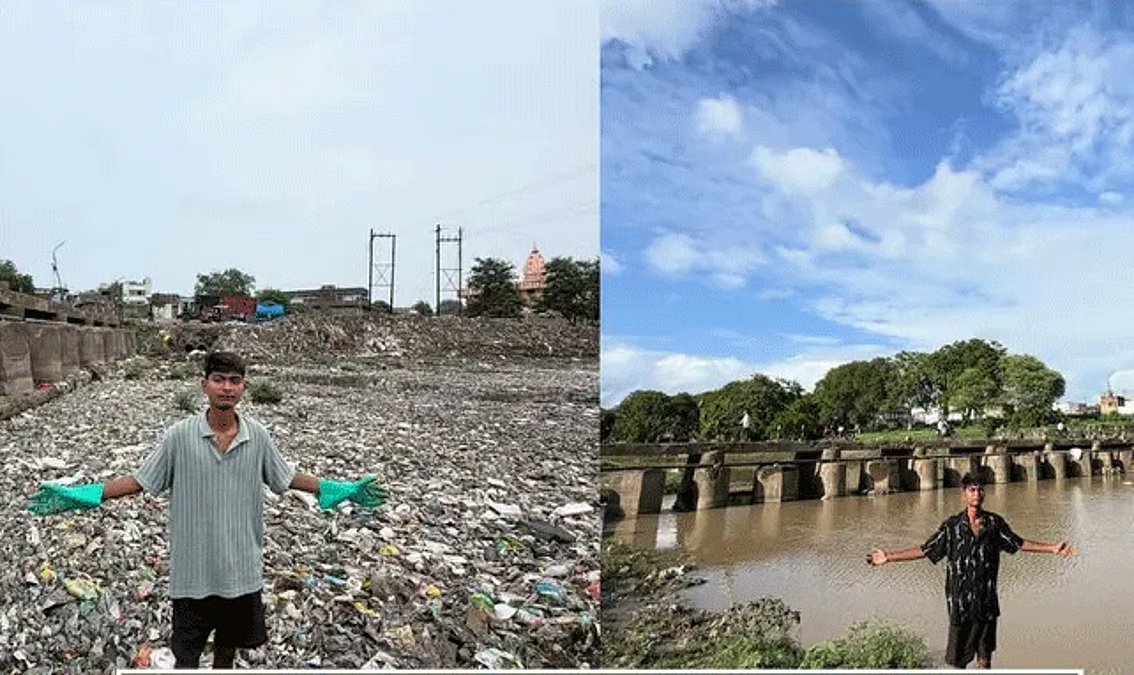
A young Biaora student spent months cleaning the polluted Ajnar River by hand. The bigger story is not just what he cleaned — but why nobody had to ask him to start.
By Saurabh Mahto6 min read
Share this story
He Saw a Dirty River. So He Got Into It Himself.
On most days, the Ajnar River in Biaora, Madhya Pradesh, was something people passed by rather than something they stopped to look at.
Plastic waste had accumulated along its banks. Bottles, weeds, algae and other debris had turned parts of the waterway into what resembled a dumping ground.
Then a young college student decided to do something that did not begin with a government order, a funded campaign or a large volunteer group.
He simply started cleaning it.
His name is Surendra Singh Choudhary. Online, he is better known as Bittu Tabahi.
And his story raises a question much bigger than one river:
What happens when an ordinary person decides that a problem is no longer someone else's responsibility?
It started on Republic Day
According to Choudhary's account reported by The Times of India, he had been thinking about the river for some time.
Whenever he passed the river or visited a nearby temple, he noticed its deteriorating condition. The smell, the garbage and the neglected surroundings stayed with him.
On January 26, 2026, he decided to stop thinking about it and start working.
When a Name Disappears From the Voter List, What Happens to Democracy?
A few friends initially helped. But over time, their participation faded and Choudhary continued returning to the river.
The cleanup became a largely solo mission.
There was no dramatic launch
That is one of the unusual things about this story.
There was no major campaign announcing his arrival.
No large machine was waiting at the riverbank.
No institutional team had assembled around him.
Reports say Choudhary manually removed plastic, bottles, algae, weeds and other accumulated waste from sections of the Ajnar River.
In a later report, The Times of India described the effort as something that began without government funding, machinery or formal backing.
That changes how the story looks.
It is easy to read this as a simple story about one determined young man.
But another interpretation is more uncomfortable:
Why had the situation become so bad that one person felt compelled to enter the river himself?
The real problem wasn't just the garbage
Cleaning visible garbage is the easy part of understanding the problem.
The harder question is why the garbage keeps returning.
A river does not become polluted in a single day.
Waste reaches waterways through repeated everyday behaviour — dumping, poor waste management, weak enforcement and the assumption that someone else will eventually clean it.
That means Bittu's work is both inspiring and incomplete.
He can remove what is already there.
But he cannot solve the system that keeps putting it there.
And that may be the most important angle in the entire story.
When criticism arrived
As his videos spread online, Choudhary's cleanup work attracted attention from far beyond Biaora.
But visibility also brought criticism.
Some people questioned whether documenting the work on social media meant that the effort was partly about publicity.
Choudhary pushed back against that criticism, saying the purpose was the work itself rather than credit.
The disagreement reveals something interesting about how we judge public action today.
When someone does nothing, we rarely ask whether they are doing it for attention.
But when someone does something visible, we often ask whether attention was the real reason.
That is a difficult standard to apply consistently.
The internet changed the scale of the story
For months, the cleanup was local.
Then the videos began spreading.
Before-and-after images showed visible changes in sections of the river and turned a local cleanup effort into a national conversation.
Social media did what traditional civic systems often struggle to do quickly:
It made a neglected local problem visible to millions of people.
That visibility brought praise, criticism and eventually attention from outside India.
According to recent reports, Boyan Slat, founder and CEO of Dutch environmental organisation The Ocean Cleanup, invited Choudhary to join the organisation after seeing his work.
A local cleanup effort had suddenly crossed an international boundary.
But this isn't really a story about one man
Calling Bittu a hero is easy.
Understanding what his story says about everyone else is harder.
If a single student can identify a polluted river and spend months trying to restore it, the question isn't only:
"How inspiring is he?"
It is also:
"Why was this allowed to become normal in the first place?"
That question applies beyond Biaora.
Across India, rivers, lakes and ponds often sit at the intersection of public behaviour, municipal systems, environmental enforcement and political priorities.
A person can remove thousands of pieces of waste.
But a functioning system should make it difficult for those thousands of pieces of waste to reach the water in the first place.
The uncomfortable lesson
There is a tempting conclusion to stories like this:
One brave individual stepped up, and everything changed.
Real life is rarely that simple.
Individual action can create awareness.
It can start a movement.
It can prove that change is possible.
But lasting environmental recovery requires something bigger — consistent waste management, public participation, institutional support and long-term maintenance.
Bittu's story matters because he acted before all of those things were in place.
But his story should not become an excuse for those things to remain absent.
What happens after the viral moment?
This may ultimately be the most important question.
The internet moves quickly.
Today, millions may watch a river being cleaned.
Tomorrow, something else will become viral.
The real measure of the effort will be what happens after the attention moves elsewhere.
Does the river remain cleaner?
Does public behaviour change?
Does local administration stay involved?
Does the community take ownership?
And does the cleanup become a sustained system rather than a one-person mission?
Those answers will determine whether this was simply an extraordinary viral story — or the beginning of something lasting.
The Next Angle
Bittu Tabahi's story is easy to frame as a motivational tale about a young man who refused to wait for others.
But there is another way to see it.
Sometimes the most powerful act of protest is simply doing the work everyone assumed someone else would do.
The bigger challenge is making sure that one person's extraordinary effort does not have to remain extraordinary.