Why India and Russia Are Rebuilding Their Strategic Partnership
As global tensions reshape trade, defence and diplomacy, India and Russia are working to keep their long-standing relationship strategically relevant.
By Editorial Desk6 min read
Share this story
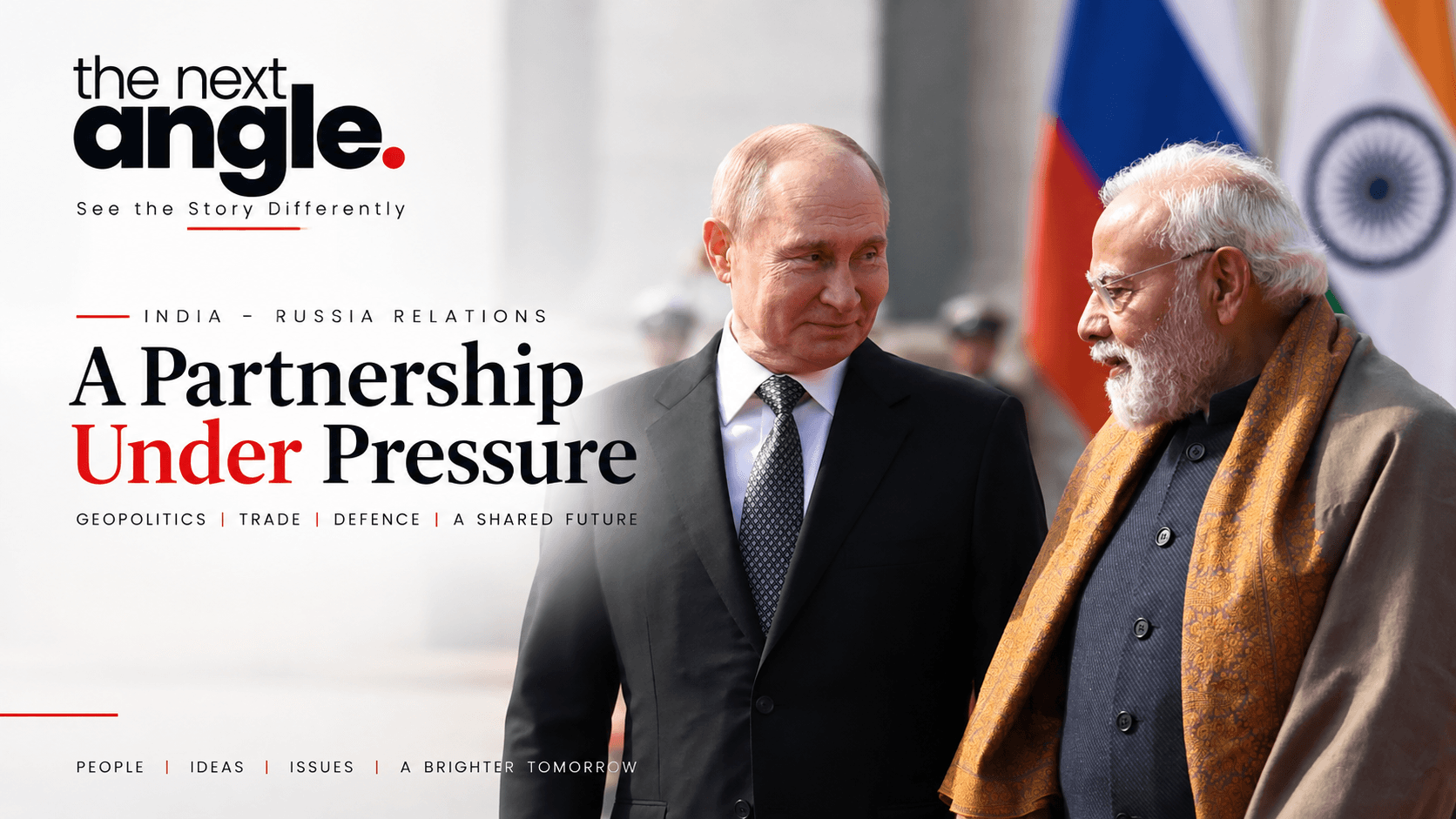
India and Russia continue to explore stronger cooperation in trade, defence and strategic affairs. The latest talks between Prime Minister Narendra Modi and Russian President Vladimir Putin highlight how both countries are trying to protect their partnership in a rapidly changing global order.
Why India and Russia Are Rebuilding Their Strategic Partnership
For decades, India and Russia have maintained a relationship built on defence cooperation, diplomatic trust and strategic understanding. But today, that relationship is operating in a very different world.
Global conflicts, changing trade routes, Western sanctions, energy pressures and the growing competition between major powers have made every international partnership more complicated. For India and Russia, the challenge is no longer simply maintaining old ties. It is finding new reasons to remain important to one another.
Recent talks between Prime Minister Narendra Modi and Russian President Vladimir Putin focused attention on trade, defence and the wider strategic relationship between the two countries.
Reuters
These discussions come at a time when both nations are attempting to balance their traditional partnerships with new economic and geopolitical realities.
A relationship built on strategic trust
Degrees Are Increasing, but What Skills Are Employers Actually Looking For?
During the Cold War, the Soviet Union became one of India’s most important strategic partners. Cooperation expanded across defence, space, energy, heavy industry and technology.
Even after the Soviet Union collapsed, India maintained close relations with Russia. Moscow continued to play a major role in India’s defence ecosystem, while New Delhi valued Russia’s support on several international issues.
This relationship was never based only on short-term business interests. It was also shaped by decades of political and strategic trust.
However, long-term relationships must also adapt. The world that created the India–Russia partnership has changed significantly.
Defence remains a central pillar
Defence cooperation continues to be one of the strongest foundations of India–Russia relations.
Russia has historically supplied India with aircraft, helicopters, naval systems, missiles and other military equipment. Many parts of India’s defence infrastructure have been developed through Russian or Soviet-era cooperation.
For India, maintaining this relationship is important because defence systems require long-term support, spare parts, training and technical cooperation.
For Russia, India remains a major defence partner and an important market at a time when Moscow faces increasing pressure from Western countries.
But India is also diversifying its defence purchases. Cooperation with countries such as France, the United States and Israel has grown over the years. This means Russia can no longer assume that its position in India’s defence sector will remain unchanged.
The future of defence cooperation will therefore depend on technology transfer, local manufacturing, delivery timelines and the ability to develop modern systems together.
Trade is the next major test
Defence has traditionally dominated the relationship, but trade and investment are becoming increasingly important.
India and Russia have discussed ways to increase bilateral trade, improve payment mechanisms and reduce obstacles created by international sanctions and financial restrictions.
The challenge is that political cooperation does not automatically translate into smooth commercial activity.
Businesses need:
Reliable payment systems
Stable shipping routes
Predictable regulations
Currency settlement options
Insurance and banking access
Greater market information
If these issues are not addressed, trade may remain below its potential.
India wants stronger access to energy, fertilisers, minerals and other resources. Russia, meanwhile, needs wider markets for its commodities and products.
This creates a clear area of mutual interest. But the partnership will need more than government announcements. It will require practical systems that allow companies to do business efficiently.
Energy creates both opportunity and pressure
Energy has become another important part of India–Russia relations.
India is one of the world’s largest energy consumers, and affordable energy is essential for economic growth. Russia, as a major energy producer, can be an important supplier.
For India, Russian energy imports can support energy security and help manage costs. For Russia, Indian demand provides access to a large and growing market.
However, energy cooperation also brings diplomatic complications.
India must balance its energy requirements with relationships involving the United States, Europe and other partners. Any major energy arrangement is now closely watched through the lens of sanctions, shipping, insurance and global politics.
This means energy cooperation can strengthen the relationship—but it can also create new pressure points.
India’s foreign policy is becoming more flexible
India’s current foreign policy is based on strategic autonomy.
New Delhi does not want to become completely dependent on any single major power. Instead, it seeks to maintain working relationships with multiple countries while protecting its own national interests.
India cooperates with the United States and other Western countries in areas such as technology, defence, investment and the Indo-Pacific. At the same time, it continues to engage with Russia, Iran and other countries outside the Western alliance system.
This approach allows India to keep its options open.
For Russia, however, India’s growing engagement with the West may create uncertainty. Moscow may want stronger political support from New Delhi, while India is likely to avoid being pulled into another country’s geopolitical confrontation.
The relationship can survive this difference—but only if both sides understand each other’s priorities.
A changing global order
The India–Russia relationship is also being shaped by the rise of a more fragmented global system.
The world is moving away from a period in which one dominant power could largely shape international economic and political rules. New power centres are emerging, while countries are increasingly trying to build alternative trade, finance and security arrangements.
India and Russia both support a more multipolar world, although their interests are not always identical.
India wants a global system that gives greater space to developing economies and protects its strategic independence. Russia wants to reduce Western influence and strengthen its position in a changing international order.
These goals overlap in some areas, but not everywhere.
The future of their partnership will depend on how effectively they manage these similarities and differences.
What India wants from Russia
For India, the relationship with Russia is likely to remain valuable if it delivers practical benefits.
New Delhi will look for:
Reliable defence supplies and technology
More local manufacturing and technology transfer
Stable energy access
Greater trade opportunities
Diplomatic support on important international issues
Better connectivity and payment systems
India is unlikely to support any partnership simply because of historical sentiment. The relationship must continue to serve India’s economic, security and diplomatic interests.
What Russia wants from India
Russia also has clear reasons to maintain close ties with New Delhi.
Moscow wants:
Access to India’s large consumer market
Stable energy and commodity demand
Continued defence cooperation
Greater diplomatic engagement
Support for a multipolar global order
Stronger links with the wider Global South
India’s size, economic growth and international influence make it an important partner for Russia.
At the same time, Russia will need to recognise that India’s foreign policy is independent and not controlled by any other power.
**Can the partnership become stronger?
**
The India–Russia relationship is unlikely to disappear. Its history, defence links and strategic importance give it a strong foundation.
But the partnership cannot depend only on past cooperation.
To become stronger, both countries will need to move from traditional diplomacy to more practical collaboration in:
Advanced defence technology
Space cooperation
Nuclear energy
Critical minerals
Digital payments
Manufacturing
Education and research
Connectivity and logistics
The relationship will also need greater transparency and faster implementation of agreements.
A partnership is measured not only by official meetings but by what actually reaches businesses, industries, universities and ordinary citizens.
The bigger picture
India and Russia are not rebuilding their relationship because the world is simple. They are doing so because the world is becoming more uncertain.
For India, Russia remains an important strategic partner—but not the only one. For Russia, India represents a major market, a diplomatic bridge and a powerful voice in the Global South.
The relationship is therefore entering a new phase.
It is no longer enough to ask whether India and Russia are friends. The more important question is whether their partnership can adapt to the demands of a changing world.
The future of India–Russia relations will depend less on old slogans and more on new results.