India, Iran and the US: How Far Will New Delhi Push Strategic Autonomy?
New Delhi's engagement with Tehran shows that strategic autonomy is not simply about choosing sides. It is about keeping options open when every choice carries a cost.
By Saurabh Mahto5 min read
Share this story
India's relationship with Iran is becoming a test of its strategic autonomy. As Washington increases pressure on countries dealing with Tehran, New Delhi is trying to protect its energy, trade and geopolitical interests without abandoning its wider partnerships.
India's relationship with Iran has entered a more complicated phase.
On one side is Washington, increasingly willing to use sanctions and economic pressure against countries that continue doing business with Tehran. On the other is India's long-standing relationship with Iran — shaped by geography, energy, trade and India's broader interests in Central Asia.
New Delhi's response has been carefully measured.
Rather than publicly choosing between Washington and Tehran, India appears to be doing something more familiar: keeping both relationships alive while protecting its own room for manoeuvre.
That is the real story behind India's recent engagement with Iran.
The Meeting That Matters
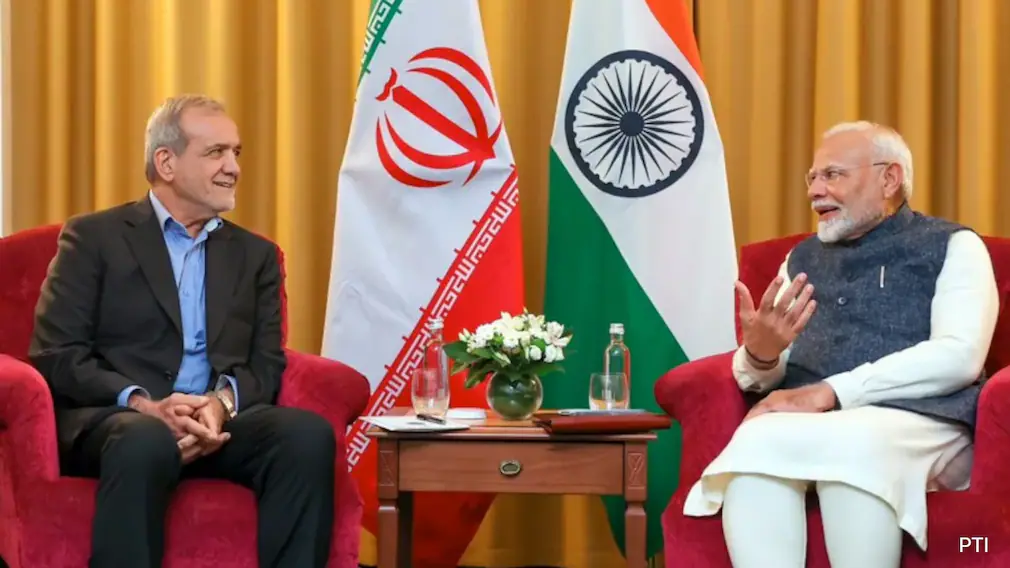
Prime Minister Narendra Modi's meeting with Iranian President Masoud Pezeshkian on the sidelines of the SCO Summit in Bishkek was significant not simply because the two leaders met, but because of when it happened.
India Faces New 100% US Tariff Risk: What the Russia Oil Bill Could Mean for Trade
The meeting came amid heightened tensions involving Iran, Israel and the United States, while Washington was simultaneously warning countries that continued economic engagement with Iran could invite sanctions.
Yet India's message remained focused on maintaining its relationship with Tehran.
Modi spoke about strengthening India's long-standing friendship with Iran, expanding trade and discussing the regional situation.
The language was deliberate.
There was no dramatic declaration against the United States. There was also no indication that India intended to distance itself from Iran.
Instead, New Delhi left itself space.
And in diplomacy, that space can be extremely valuable.
Why Iran Still Matters to India
India's relationship with Iran cannot be reduced to oil.
Iran sits at a strategically important point between South Asia, Central Asia and the Middle East. For India, engagement with Tehran has historically been connected to access, connectivity and influence far beyond the immediate bilateral relationship.
The clearest example is Chabahar.
The Iranian port gives India an alternative route towards Afghanistan and Central Asia, reducing dependence on routes that pass through Pakistan.
That makes Chabahar more than an infrastructure project.
It is part of India's larger connectivity strategy.
US sanctions have complicated this relationship before. India has previously reduced Iranian oil imports when American sanctions intensified, while Washington had also provided specific exemptions connected to Chabahar.
The larger lesson is clear: India wants the relationship with Iran, but it also knows that the cost of maintaining it can change dramatically depending on Washington's policy.
India's Energy Problem
There is another reason India cannot look at West Asia from a purely diplomatic perspective.
India's economy remains deeply connected to the region.
West Asia is an important source of India's energy supplies and a major destination for Indian workers. The Gulf is also critical for trade, investment and remittances.
That creates a fundamental strategic reality.
A major disruption in the region is not simply a foreign-policy problem for India. It can quickly become an economic problem.
Oil prices can rise.
Shipping costs can increase.
Supply chains can become uncertain.
And millions of Indians living and working across the Gulf can potentially be affected by regional instability.
This is why New Delhi has repeatedly preferred engagement over isolation.
The Strait of Hormuz Problem
The geography makes the situation even more difficult.
The Strait of Hormuz is one of the world's most important energy chokepoints. Any prolonged disruption around the waterway can affect global energy markets far beyond the Middle East.
For India, the stakes are particularly high because of its dependence on imported energy.
This creates a difficult balancing act.
India needs stable relations with Gulf countries.
It needs a working relationship with the United States.
But it also cannot simply ignore Iran, a country whose geography and regional influence directly affect India's interests.
That is why India's Iran policy often looks deliberately cautious.
It is less about taking a side and more about preventing the loss of strategic options.
Strategic Autonomy Does Not Mean Strategic Isolation
This is perhaps the most important distinction.
Strategic autonomy does not mean refusing to cooperate with major powers.
India works closely with the United States on defence, technology and the Indo-Pacific. At the same time, it maintains relationships with countries that Washington considers strategic competitors.
That can look contradictory from the outside.
But it is actually the logic of strategic autonomy.
New Delhi wants partnerships without permanent alignment.
It wants cooperation without surrendering decision-making.
And it wants the ability to speak to countries that may be on opposite sides of a conflict.
Iran is therefore not an exception to India's foreign-policy approach.
It is a particularly visible example of it.
What Washington Can — and Cannot — Do
American economic power gives Washington considerable leverage.
Secondary sanctions can make companies and governments think twice before dealing with sanctioned entities. For countries deeply connected to the US financial system and American markets, these threats cannot simply be ignored.
But pressure has limits.
India is large enough to have its own strategic calculations, and its interests in West Asia extend beyond the question of sanctions.
That means Washington can raise the cost of India's choices.
It cannot automatically determine those choices.
This distinction will become increasingly important as India navigates its relationships with both Iran and the United States.
The Bigger West Asian Picture
The regional environment is also changing.
Iran remains a major regional actor because of its geography, energy resources, military capabilities and political networks.
Any long-term security arrangement in West Asia therefore has to account for Iran's role.
For India, this creates a practical reason to maintain communication.
Even when New Delhi disagrees with Tehran, cutting off the relationship entirely would reduce India's ability to influence events or protect its interests.
Diplomatic relationships are not rewards.
They are tools.
And sometimes the most useful relationship is the one that allows you to keep talking to someone with whom you disagree.
What India's Message Really Says
India's message can therefore be read on several levels.
To Iran, it says that India does not intend to abandon the relationship simply because external pressure has increased.
To the United States and other partners, it signals that India's foreign policy will ultimately be guided by its own national interests.
And to the wider Global South, it reinforces India's image as a country trying to maintain an independent foreign-policy position in an increasingly divided world.
None of this means India has chosen Iran over the United States.
It has not.
The more accurate interpretation is that India is refusing to accept that it must choose one relationship at the expense of the other.
The Next Angle
The real test of India's strategic autonomy will not come from diplomatic statements.
It will come when the costs become higher.
If sanctions tighten, energy markets become more volatile, shipping routes face greater disruption and pressure from Washington increases, how much room will India still have?
That is where the theory of strategic autonomy meets reality.
For now, New Delhi's approach is clear: keep talking, keep trading where possible, protect strategic interests and avoid unnecessary alignment.
India's Iran policy is therefore not simply about Iran.
It is about how an emerging power navigates a world where the pressure to choose sides is becoming stronger.